
Centripetal acceleration: a = ω²R
Verify the relationship a = ω²·R by spinning with a smartphone held at arm's length.
Activity Summary
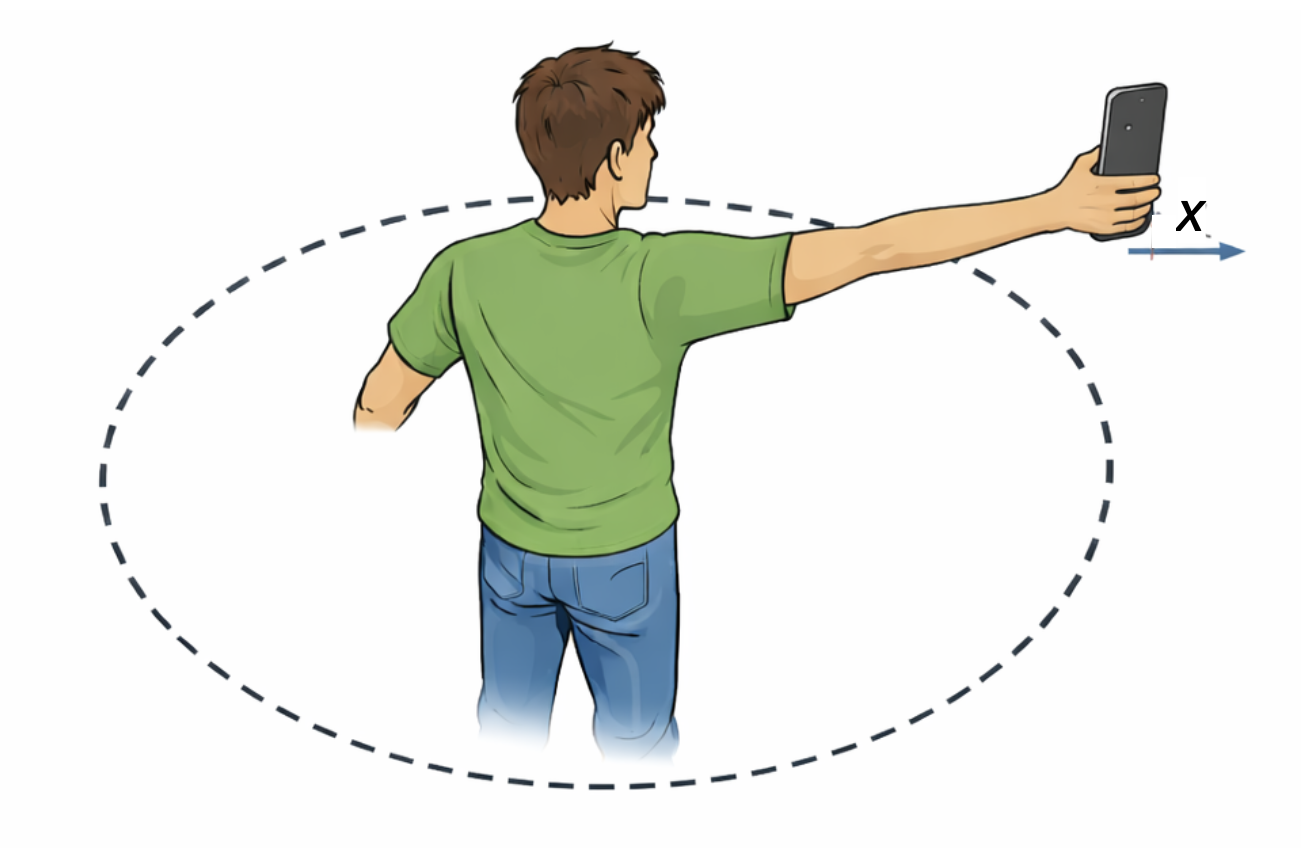
The student spins on their axis while holding the smartphone vertically at arm's length and records the acceleration along the X axis with FizziQ. By timing three complete rotations, they calculate the angular velocity ω, then compare the theoretical value a = ω²·R with the measured average acceleration.
Introduction
Have you ever felt that force pushing you outward when spinning rapidly on a merry-go-round or turning in a car? This sensation is related to centripetal acceleration, a fundamental quantity of circular motion.
In 1659, Christiaan Huygens was the first to mathematically formulate the relationship between centripetal acceleration, rotational speed, and the radius of the described circle. This discovery allowed Newton to understand why the Moon stays in orbit around the Earth.
In this activity, you will become the experiment yourself: by holding your smartphone at arm's length and spinning on your axis, you will directly measure centripetal acceleration using the accelerometer. You can then verify whether the famous formula a = ω²·R gives the correct result.
Learning Objectives
- Measure centripetal acceleration using the smartphone's accelerometer.
- Calculate angular velocity ω from the number of rotations and measured time.
- Experimentally verify the relationship a = ω²·R.
- Analyze sources of discrepancy between theoretical and experimental values.
- Interpret an acceleration vs. time graph.
Scientific Concepts
Instruments and sensors
Scientific instruments
- Single-axis accelerometer (X-axis acceleration measurement)
Sensors
- Accelerometer
FizziQ Features
- Experiment notebook — Displays the X-acceleration vs. time graph and lets students identify the steady-rotation zone.
- Statistics tool — Computes the average acceleration over the selected zone for comparison with the theoretical value.
Required Materials
- - Smartphone or tablet with the FizziQ app - Measuring tape or ruler to measure arm length - Clear space to spin freely without obstacles - FizziQ experiment notebook to record and analyze the acceleration data - Note: the protocol remains adaptable to any comparable accelerometer-based measurement tool.
Experimental Protocol
Open the FizziQ app on your smartphone.
In the Measurements menu, select the accelerometer and choose the X Acceleration component (horizontal axis when smartphone is held vertically).
Measure your extended arm length from your rotation axis (your body) to the center of the smartphone. Note this value R in meters (typically between 0.60 m and 0.80 m).
Hold the smartphone vertically, screen facing you, arm extended horizontally. The smartphone's X axis is then directed along the radius of the circle you will describe.
Press the FizziQ record button to start data acquisition.
Rotate steadily on yourself while keeping your arm well extended and horizontal. Complete exactly 3 full rotations at constant speed.
Stop recording once the 3 rotations are complete.
On the acceleration graph in your notebook, note the total rotation time t in seconds. Calculate the period T = t / 3, then the angular velocity ω = 2π / T (in rad/s).
Calculate the theoretical centripetal acceleration: a_th = ω² × R.
In FizziQ, display the X acceleration graph vs. time. Identify the zone corresponding to regular rotation (excluding start and stop phases).
The average is displayed by pressing the Statistics button.
Compare the experimental average acceleration value with the theoretical value a_th = ω² × R. Calculate the relative error between the two values.
Printable version: lab handout (PDF) with the protocol, materials and questions, for students without a screen in front of them.
Also possible with other apps: Phyphox users know this measurement as the "Centripetal acceleration" experiment. The protocol above works with any app that offers the same instrument; FizziQ adds the experiment notebook to record, plot and export the results, and the QR code to share the protocol with a class. See FizziQ for Phyphox users.
Expected Results
The measured acceleration along the X axis shows a relatively constant value during the regular rotation phase, framed by transitional phases at start and stop.
For a rotation period of 2 s and an arm of 0.70 m, the theoretical centripetal acceleration is approximately 6.9 m/s². The average value measured by the accelerometer should be of the same order of magnitude.
Fluctuations around the average value are visible on the graph, due to irregularities in rotation and parasitic movements of the arm and hand.
The relative error between theoretical and experimental values is typically between 5% and 20%, depending on rotation regularity and timing precision.
Scientific Questions
- What happens if you double the rotation speed? Is the acceleration doubled or quadrupled?
- How does centripetal acceleration vary if you shorten your arm (smartphone closer to body)?
- Why doesn't the accelerometer measure the gravitational component on the X axis when the smartphone is vertical?
- What are the main sources of error in this experiment and how can they be reduced?
- What is the relationship between centripetal acceleration felt on a merry-go-round and that measured here?
Scientific Background
When an object moves in a circle at constant speed, it experiences an acceleration directed toward the center of the circle, called centripetal acceleration. This acceleration does not increase the object's speed but constantly changes the direction of its velocity vector to maintain the circular trajectory.
The fundamental relationship linking centripetal acceleration a, angular velocity ω and radius R of the circle is: a = ω² × R. It can also be expressed in terms of linear velocity v: a = v² / R, since v = ω × R.
In this experiment, the smartphone held at arm's length describes a circle of radius R (the arm length). The accelerometer's X axis, perpendicular to the screen, is oriented radially, i.e., along the circle center – smartphone direction. It therefore directly measures the centripetal component of acceleration.
Extensions
- Vary the rotation speed (spin faster or slower) and plot a vs. ω² to verify proportionality.
- Modify the radius by holding the smartphone at different distances from your body (bent arm, extended arm) and compare accelerations.
- Compare results obtained by several students with different arm lengths.
- Use the FizziQ Web Centrifuge simulation to compare experimental results with simulation.
Frequently Asked Questions
Why choose the accelerometer's X axis rather than another axis?
When the smartphone is held vertically facing you, the X axis is perpendicular to the screen and points in the radial direction of the described circle. It therefore directly measures centripetal acceleration, which is directed toward the circle's center.
Doesn't the accelerometer also measure gravity?
The accelerometer measures proper acceleration, which includes gravity. However, when the smartphone is vertical, gravity acts along the Y axis (vertical) and has no component along the X axis (horizontal). The measurement on X therefore directly gives centripetal acceleration.
How many rotations should I do for good results?
Three rotations are a good compromise: enough to have an exploitable regular rotation zone, but not too many to lose balance or get tired. The key is to maintain rotation speed as constant as possible.
Detailed Description
The student spins on their axis while holding the smartphone vertically at arm's length and records the acceleration along the X axis with FizziQ. By timing the duration of three complete rotations, they calculate the angular velocity ω, then compare the theoretical value a = ω²·R with the measured average acceleration. This experiment allows students to experimentally verify the centripetal acceleration law and understand its parameters. FizziQ's accelerometer module records the X-axis acceleration in real time, and its experiment notebook lets students plot the acceleration-versus-time graph, select the steady-rotation zone, and compute its average value for direct comparison with the theoretical prediction.
Ready to start?
Download FizziQ and try this activity with your students.