top of page

Our blog
Interesting articles published regularly on education and science teaching, the use of FizziQ, or scientific articles.
Seven smartphone experiments to understand space travel
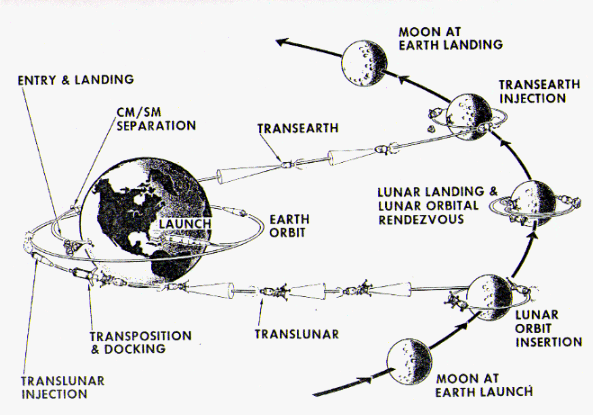
Jessica Meir has been floating in the ISS since 14 February 2026. Artemis II just brought back four astronauts from a historic flyby of the Moon on 10 April. Space exploration has never been more present in the news, and the questions it raises (how do you stay in orbit? why do you float in space? how do you slow down to land on the Moon?) are at the heart of middle school and high school physics curricula. In this article, we propose seven experiments that can be performed w

Christophe Chazot
May 513 min read


Why is a smartphone compass not affected by magnets?
You have probably already tried to disturb a compass by bringing a magnet close to it, but have you ever tried the same experiment with your smartphone's electronic compass? In the video below, we conducted the experiment, and the result is surprising: the smartphone's compass appears to be unaffected by the presence of a magnet. Why such behavior? As a scientist, can we trust the magnetometer data? And what are the implications for measuring magnetic fields with a smartphone
Christophe Chazot
Apr 289 min read


Five Doppler Effect Experiments with a Smartphone
Discovered in 1842, the Doppler effect has established itself as an essential investigation tool in modern science. This article details five activities adapted to different learning levels, to be carried out in class, at home or outdoors, simply using a smartphone or tablet. We will also provide specific advice to optimize their implementation. These practical experiments offer a unique opportunity to grasp the concrete applications of the Doppler effect in our daily lives,
Christophe Chazot
Apr 2814 min read


The Science Behind Smartphone Accelerometers
The accelerometer has become one of the most important sensors in our cell phones. In this article we find out in detail what it is used for and how it works. Contents What is the accelerometer used for in a smartphone? - The different ways of calculating acceleration - Operating principle of the accelerometer - Measurement of displacement - MEMS technology - Absolute acceleration and linear acceleration - Precision and calibration of a MEMS accelerometer What is the accelero
Christophe Chazot
Apr 287 min read


Six science experiments with the tone generator
Tone generators, also called frequency generators or synthesizers, can be used to conduct many exciting scientific experiments to understand sound waves. In this article we describe 6 science projects that use the tone generator and which can be adapted to your specific needs. Table of content What is a tone generator ? - Create an acoustic beat - Generate an anti-sound - Synthesize the timbre of a oboe - Perform an audiogram - Protect yourself from too loud sounds - Meas
Christophe Chazot
Apr 289 min read


Could we see a sound?
You can see the swell, a mechanical wave that propagates on the surface of the water; you can also see an earthquake; but can we see a sound wave? And what if it were possible? We will see that this seemingly simple question opens up exciting educational scenarios for using the inquiry method with students. 1. Can we see a sound ? Experience shows that we cannot see a sound: whether the music is loud or not, whether a note is high or low, the visual appearance of the world ar
Christophe Chazot
Apr 288 min read


Seven experiments to measure the speed of sound in the air
Calculating the speed of sound becomes a simple and engaging task with the use of a smartphone, transforming this commonly abstract concept into a tangible learning experience. For students, this exercise is particularly gratifying as it demystifies the complexities of sound waves, allowing them to explore its various physical properties through a device that's a familiar staple in their everyday lives. In this article, we introduce seven experiments, each utilizing a smartph
Christophe Chazot
Apr 289 min read


Eight experiments with the FizziQ Web Simulation module
Galileo's pendulum, astronaut centrifuge, Boyle's law, waves on a lake: these are classic physics experiments that would be interesting to perform with real equipment such as a smartphone, but that sometimes cannot be carried out physically. That is why we created a simulation tool within FizziQ Web — not to replace experimentation in the physical world, which remains the only truly relevant approach for analysing the world around us, but to make experimentation easier when i
Christophe Chazot
Apr 113 min read


Before the Algorithm: How Teachers Built the Digital Classroom
The history of educational science software is, first and foremost, a history of teachers. Since the 1990s, teachers have been the ones building the tools that still equip thousands of classrooms today, coding in their own time, on evenings and weekends, for no pay. Over time, universities and foundations extended this offering with Scratch, PhET, Phyphox, and others: free software, often open source, adapted to real classroom needs because it was built by people who work the
Christophe Chazot
Mar 418 min read


Is space a giant refrigerator for artificial intelligence?
In February 2026, Elon Musk announced his intention to install data centers in orbit to run artificial intelligence. Very quickly, one argument dominated the comments: in space, cooling would be “free”, since it is very cold there. This widely shared claim is nevertheless false. It reveals a common confusion between temperature, heat, and heat transfer. Above all, it offers a valuable opportunity to develop critical thinking and to revisit simple but fundamental questions: wh
Christophe Chazot
Feb 1014 min read


The Shepard Tone: a sound illusion to explore with FizziQ
The Shepard Tone : an infinite rise… or almost You're surely familiar with the Penrose staircase illusion, the seemingly endless staircase popularized by the artist M.C. Escher. But are you familiar with the Shepard Tone, an acoustic illusion conceived in the 1960s by the American psychologist Roger Shepard, which creates the impression that a sound rises—or falls—without ever reaching a peak? Let's explore and analyze this astonishing sound effect with the FizziQ app. The Or
Christophe Chazot
Nov 15, 20254 min read


FizziQ Web: Experimental physics on the big screen
Quand on enseigne les sciences au collège ou au lycée, utiliser des smartphones en classe n'est pas toujours évident. C'est pourquoi nous avons développé FizziQ Web, une version navigateur de l'application mobile qui s'adapte parfaitement aux ordinateurs et à leur écran horizontal.
Christophe Chazot
Sep 3, 20252 min read


Welcome to FizziQ Anthracite
We’re excited to introduce FizziQ Anthracite , our brand-new version, available today for all beta testers. It’s a major update, with...
Christophe Chazot
Jun 25, 20253 min read


The new FizziQ spreadsheet
The FizziQ Spreadsheet is an integrated tool within the app that allows users to enter, manipulate, and visualize numerical data....
Christophe Chazot
Apr 24, 20253 min read


Ask FizziQ : our new AI tool
Ask FizziQ is a smart scientific assistant integrated into the FizziQ app. It allows you to ask questions about scientific concepts,...
Christophe Chazot
Apr 24, 20253 min read


Add mathematical formulas to the experiment notebook
FizziQ's Text Input module is a sophisticated component that allows users to enter and display rich text, with special support for...
Christophe Chazot
Apr 24, 20252 min read


How to use the FizziQ video library for motion analysis
For teachers looking to organize a video analysis session of a movement, one of the main challenges is often finding a suitable video....
Christophe Chazot
Feb 5, 20253 min read


Education and AI: How science can facilitate learning artificial intelligence
The integration of artificial intelligence (AI) in education presents exciting opportunities to enrich learning experiences and prepare...
Christophe Chazot
Oct 21, 202424 min read


Seven Experiments to Understand the Greenhouse Effect and Global Warming
The greenhouse effect, at the origin of the phenomenon of global warming, is difficult to show by simple experiments. Many proposals are however available on the internet but few are really reproducible and many give poor physical representations of the phenomenon [1] . This article offers practical methods and accessible tools to help teachers and educators explain this phenomenon in an engaging way. A popular greenhouse effect experiment - The challenges of the greenhouse
Christophe Chazot
Jul 2, 202414 min read


12 famous experiments to recreate with your smartphone
Did you know that you can recreate the groundbreaking experiments of famous scientists using just a smartphone? In this article, we...
Christophe Chazot
May 16, 202416 min read
bottom of page