
The integration of artificial intelligence (AI) in education opens fascinating perspectives for enriching learning, but it raises an essential question: how can we use this tool without harming the development of students’ critical thinking and autonomy?
To explore this question, we propose an activity that can be carried out in schools: AI-enhanced practical experiments. Science offers an ideal framework for exploiting the full potential of current generative models. Already adopted by scientists to accelerate their research, AI can intervene at almost every stage of scientific investigation: literature review, data analysis, modeling, and dissemination of results. In a practical experimentation context, it can bring new motivation and multiply pedagogical possibilities.
In the following paragraphs, you will discover how studying the oscillation of a smartphone at the end of an elastic band allows for a fruitful dialogue between student and AI.
An AI-Enhanced Scientific Investigation Method
Unlike traditional pedagogical scaffolding, generally occasional and led by the teacher, AI integration allows continuous support, at the student’s request, throughout the investigation process.
The investigation method is based on the idea that students learn more effectively by being active and exploring on their own, rather than passively receiving information. In this method, the student uses all available tools to “investigate” a phenomenon like a researcher.
Our proposal is to integrate AI into this process to amplify students’ investigation capabilities. The objective we seek is that its reasoned use encourages students to go further in questioning and the investigation process. Equipped with AI tools, their means are multiplied and amplified. The scientific method is reinforced because students can focus more on its application and critical reflection.
An AI-enhanced scientific investigation may include the following steps:
- Literature Review: The student uses virtual assistants to more easily conduct an exhaustive search of different aspects of the problem and better understand the issues.
- Experimentation: AI can guide the student on the best instruments to use and mistakes to avoid when carrying out the experimental part.
- Data Analysis: The student uses AI to analyze data through dialogue, identify patterns or anomalies, and represent data graphically.
- Modeling: The student exchanges with AI to finalize a theoretical model based on observations and experimental data.
- Model Study and Discussion: The student uses AI to analyze model behavior under different conditions, including limit values, and explore sensitivity to parameters.
- Applications and Innovation: The search for applications is facilitated by AI’s exhaustive database.
- Conclusions and Communication: The student and AI collaborate to obtain a clear, logical, and coherent activity report.
- Sharing: The student and AI agree on the best way to structure and disseminate the communication.
The pedagogical objective of the session is to show students how AI can help them go further in their research, how to organize their work with this tool, which dialogues to initiate, discover the strengths and weaknesses of these models, and finally better understand how to get the best from them.
Study Subject and Practical Aspects
In this article, we propose to carry out scientific investigation work on a physical phenomenon that is simple for students to implement, but complex enough for AI’s role to be significant. We position this lab within the framework of the first-year program, in the “Physics-Chemistry” or “Engineering Sciences” specialty. The complexity of the phenomenon studied deliberately goes beyond program expectations, with the objective of encouraging students to seek AI’s help and push their limits.
For this article, we choose the following challenge for students: “Combining an experimental approach with the use of AI, study the mechanics of a vertical elastic pendulum using your smartphone’s accelerometer and write a scientific publication.”
The publication must include the usual elements of scientific research: literature review, experimental manipulation, data analysis, modeling and connection to theory, model study and discussion, applications, and communication.
To facilitate this manipulation, students are provided with a 40 cm elastic band that will serve as a spring, as well as a plastic bag to place the smartphone in. The exercise can be done in a laboratory or classroom, provided pendulums can be suspended there.
For AI, we use ChatGPT in this article, but any other AI would give equivalent results, and we encourage everyone to choose the system of their choice. These tools evolve very quickly, so other possibilities than those described may exist. In practice, students can use classroom computers if available, or tablets and smartphones allowing access to the dedicated ChatGPT application.
Calibrating the AI
Before beginning an experimental study, instruments must be calibrated. The same goes for AI. This process is called prompting. Prompts are the instructions or questions provided by the user to guide the AI in its response. In other words, a prompt is the starting point that tells the AI what the user wants to obtain in terms of information or help.
Prompts are used to:
- Guide responses: A prompt allows AI to understand the context and objective of the question. For example, a precise and well-formulated prompt helps AI generate a more relevant and targeted response.
- Define tone and structure: The type of prompt can indicate to AI the expected response style (formal, informative, creative, concise, etc.). A prompt asking for a simple explanation for a high school student, for example, guides AI toward a more pedagogical and accessible tone.
- Specify actions or formats: Some prompts can ask AI to structure the response in a specific way (for example, as a list, paragraph, or practical example). This allows receiving a response that corresponds to a particular format or requirement.
- Customize results: Prompts allow adapting the response to specific needs, such as requesting an explanation adapted to a certain level of knowledge or a specific field (sciences, history, technology, etc.).
To begin work with a generative model, it is therefore important to write an initial prompt that defines the context, the research objective, the type of responses desired, and the complexity level of responses. It is essential that the student and their group, with the teacher’s help, define one or more introductory prompts adapted to the research and student level. The risk if this introductory phase is not followed is that AI gives results that are too complex or poorly adapted to the students’ level.
Sample Dialogue with ChatGPT
Question: In what follows, I am a first-year science student and with my group we want to study the vertical movement of a pendulum attached to an elastic. For this, we will do an experiment to collect data provided by the pendulum’s accelerometer. We will ask you questions, make sure to help us but remember that we are only in first year and the answers should be concise and not too complicated.
Response: Noted! I’ll be here to help you with simple and concise answers. What’s your first question?
Literature Review
Literature review using artificial intelligence is the simplest and most common use of generative models. However, within the scientific investigation method framework, AI brings important pedagogical assets.
The objective of the literature review is to provide students with the theoretical foundations necessary to understand the oscillating pendulum, exploring key concepts such as oscillations, damping, and mathematical modeling. It also prepares them to use modern measurement tools, such as smartphone sensors, and lays the groundwork for analysis and modeling of experimental data. Finally, it encourages structured scientific reflection before moving on to experimental manipulation.
AI is pedagogically interesting in this context because it allows rapid access to precise information adapted to their specific questions through interactive dialogue. It guides their reflection by suggesting relevant avenues and clarifying complex concepts. AI personalizes learning by adapting to students’ level of understanding, while synthesizing information to allow them to focus on the essential. By facilitating understanding and guiding research, AI allows students to structure their scientific approach more fluidly and efficiently.
Sample Dialogue with ChatGPT
Question: Why is this pendulum different from a simple pendulum?
Response: The pendulum attached to an elastic is different from a simple pendulum because the elastic can stretch and contract. This changes the pendulum’s length during its movement, making its behavior more complex. In a simple pendulum, the length is fixed and the movement is regular, but with an elastic, the force varies depending on the stretch, creating a more irregular and nonlinear movement.
Question: What is the mathematical equation for acceleration as a function of time?
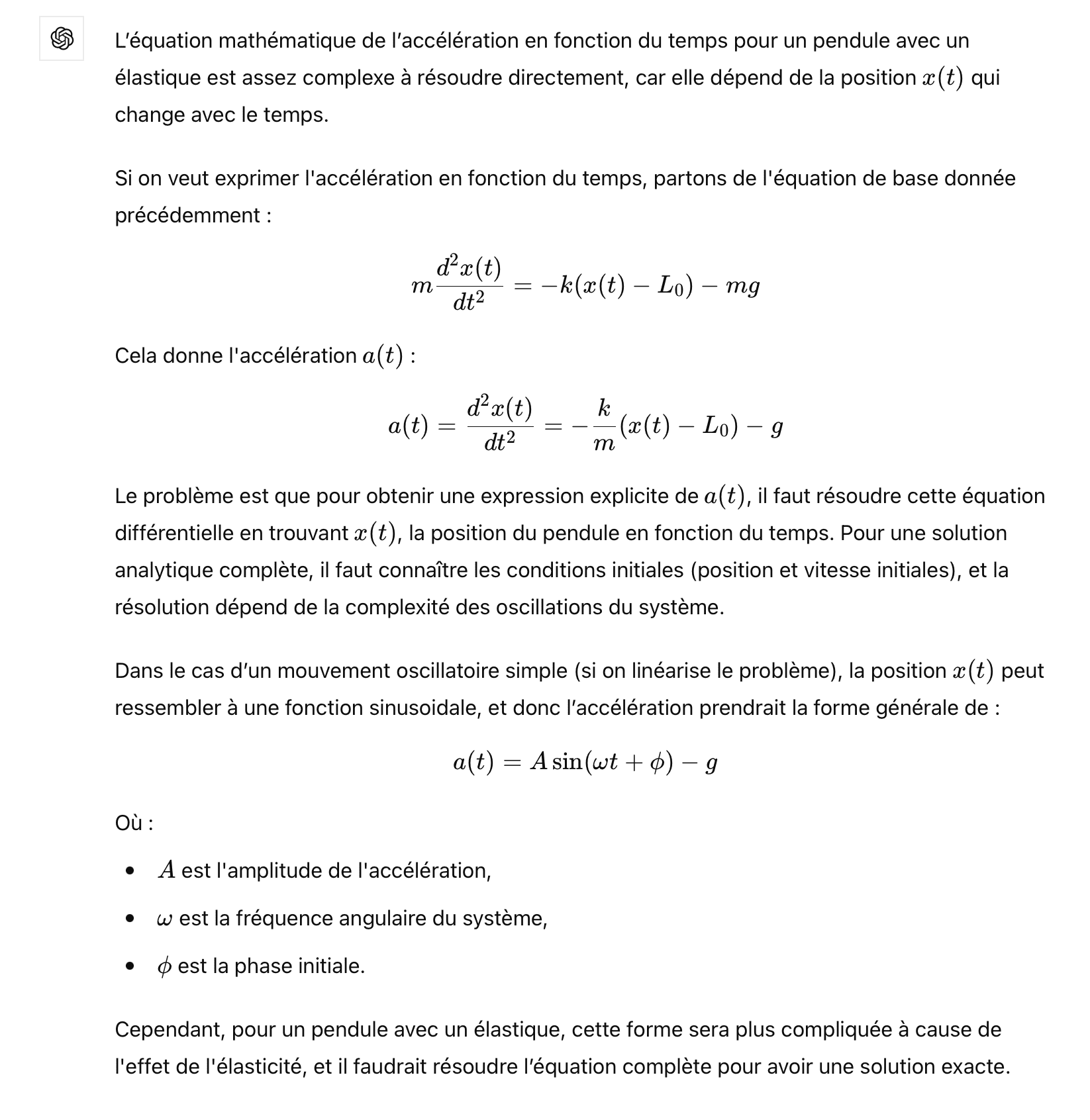
Question: What other questions should I ask you to do complete literature review?
Response: To conduct a complete literature review on the elastic pendulum, here are some additional questions to ask, which will allow you to explore different aspects of the subject:
- Historical aspects: What are the first historical works on the elastic pendulum and how did they influence modern physics?
- Theoretical and mathematical aspects: What are the main differential equations associated with elastic pendulum movements? What are the differences between linear and nonlinear behavior of the elastic pendulum?
- Comparison with other oscillating systems: What are the differences between a simple pendulum, a conical pendulum, and an elastic pendulum?
- Modern applications: How are elastic pendulum principles used in architectural structure design (e.g., bridges, buildings) to absorb vibrations?
- Practical experiments: What simple experiments can be done to study an elastic pendulum with tools like a smartphone?
Experimental Manipulation
Once the literature review is complete, the student and their group move on to experimental manipulations. To succeed in this phase, several elements must be gathered: how to set up the experimental device, safety rules to follow, recording data, and exporting them for analysis. These aspects can be submitted to AI to obtain suggestions, adjusted according to the experiment context.
It is important to note that AI is not always the ideal solution, which constitutes valuable learning for students. For example, the explanations provided by AI on the experimental device may lack precision. In this case, the student will need to experiment to find a simple and effective solution on their own. Additionally, AI like ChatGPT does not always know certain technical specifics, such as the existence of a direct norm measurement on FizziQ, which students will discover along the way.
Sample Dialogue with ChatGPT
Question: Is there a risk in doing this experiment?
Response: Doing experiments with an elastic pendulum is generally safe, but as with any experiment involving physical movements and forces, there are some precautions to take to minimize risks:
- Object falling: Make sure the object attached to the elastic (in this case, a smartphone) is well secured. A loose attachment could cause the object to fall, which could damage it or injure someone below.
- Elastic breaking: If the elastic is not designed to support the weight or tension exerted, it could break. Use an elastic adapted to the object’s mass and the intended oscillation amplitude.
- Impact with environment: The oscillating object could collide with other objects or people nearby. Make sure to clear enough space around the experimentation area.
Question: What application is best for taking measurements?
Response: The two best applications for taking these measurements are FizziQ and Phyphox:
- FizziQ: Developed specifically for science education, FizziQ allows you to measure and record sensor data intuitively. It offers tools to visualize graphs and interpret data directly via the interface. It is particularly well suited for pedagogical experiments, with a clear and simple user interface.
- Phyphox: This application is also very popular for scientific measurements. It gives direct access to smartphone sensors and offers a wide range of analysis tools, with the possibility of configuring complex experiments and customizing sensor parameters.
Data Analysis
Data analysis aims to examine recorded experimental information to extract key elements and draw conclusions about the physical characteristics of the observed movement. This approach includes removing unnecessary segments to clean data, smoothing data to reduce noise, and identifying characteristics such as movement period or oscillation damping.
Modern generative models allow not only deep graphical or statistical analysis, but also direct data reprocessing through a natural language interface, more intuitive for the student. The student can of course ask for help to perform these operations or understand their usefulness.
Quickly, the student will be able to:
- Visualize data: To obtain a graphical representation that facilitates understanding of trends.
- Clean data: By eliminating anomalies or extreme values that could distort the analysis.
- Smooth data: To attenuate random fluctuations and better see main trends.
- Calculate and interpret characteristics: Such as determining oscillation period and evaluating damping effectiveness.
- Export data: To use them in other software or share them.
Sample Dialogue with ChatGPT
Question: Make a graph of the attached CSV data
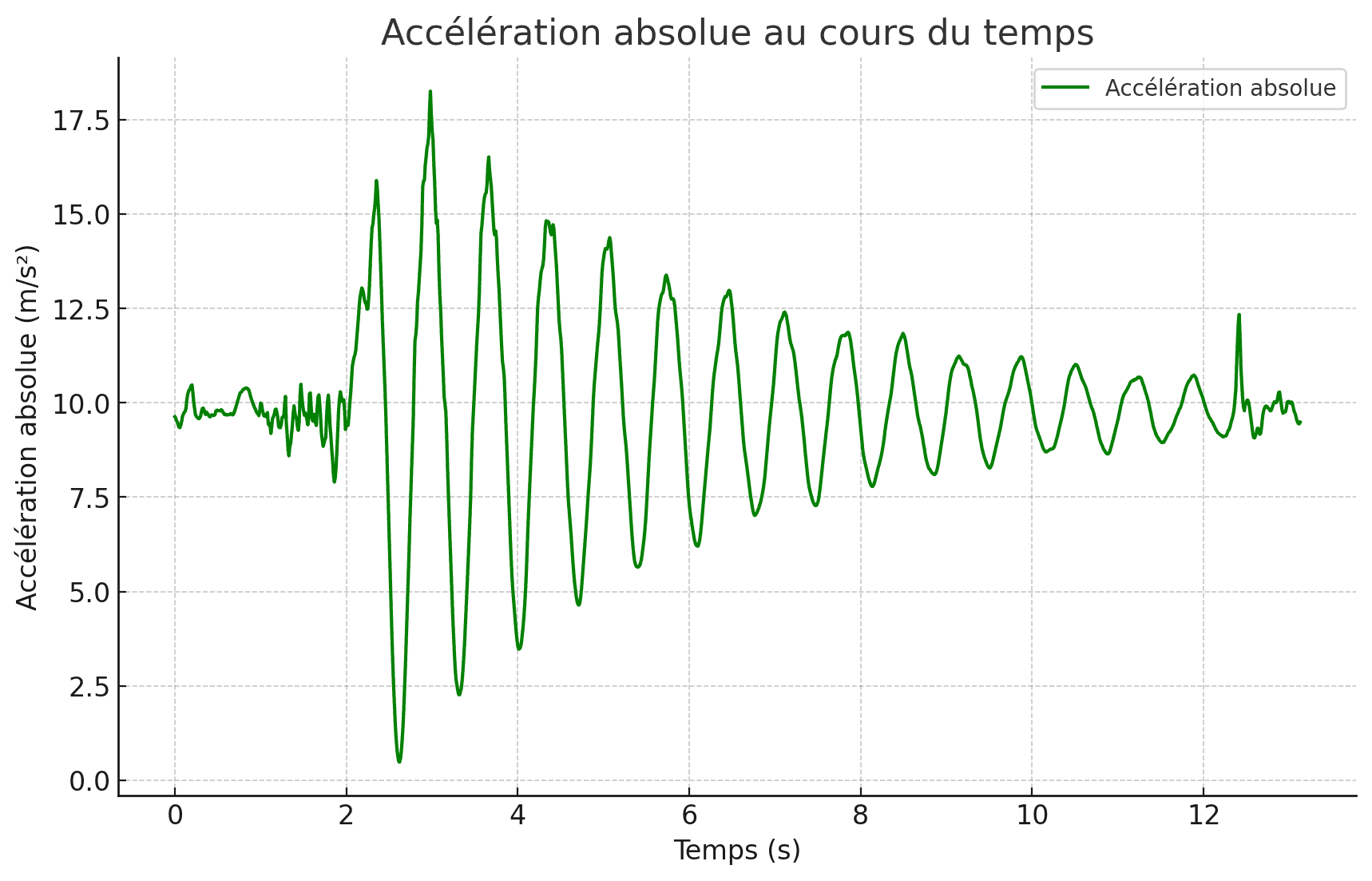
Response: Here is the graph of absolute acceleration over time, based on the data you provided. This plot shows absolute acceleration fluctuations. If you want to make changes or need other analyses, let me know!
Question: What is the phenomenon’s period?
Response: After smoothing the data and calculating periods between peaks and troughs, the average period of the phenomenon, on the smoothed data, is approximately 0.69 seconds. This calculation is based on both peaks and troughs, which give very close values, confirming the regularity of the observed phenomenon.
Question: Is the period stable?
Response: The average period is approximately 0.69 seconds, with a standard deviation of 0.015 seconds. This indicates that the period is relatively stable, with small variations around the mean. Fluctuations are minimal, suggesting that the observed phenomenon is regular.
Question: Can you study oscillation damping?
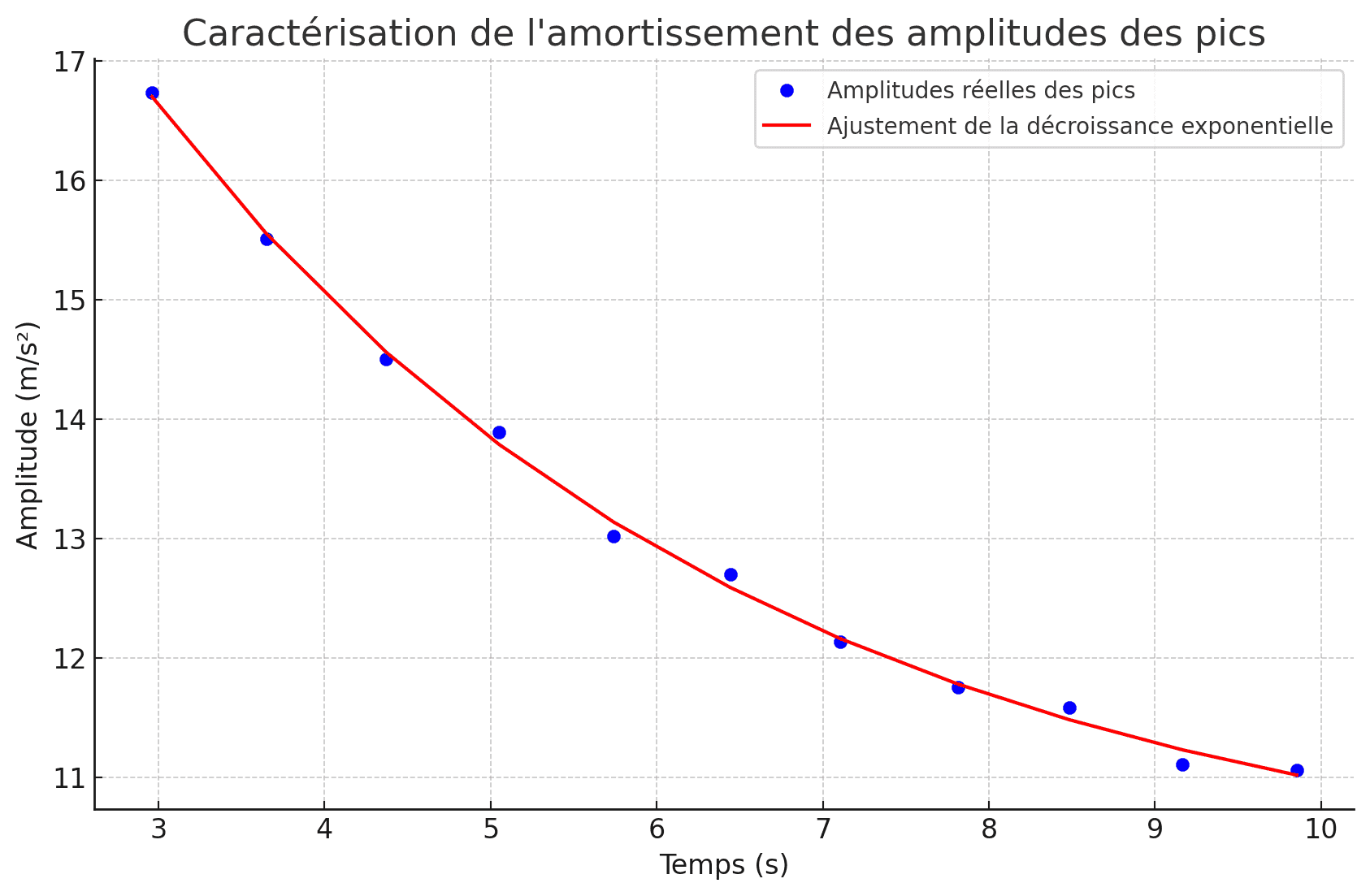
Response: The exponential decay fit on peak amplitudes does show oscillation damping. The fit parameters are as follows:
- A ≈ 15.04: initial amplitude
- B ≈ 0.273: decay rate
- C ≈ 9.99: asymptotic value toward which amplitude tends
The red curve on the graph represents the exponential decay fit, and it is clear that peak amplitudes decrease over time, indicating notable damping of oscillations.
Modeling
In scientific reasoning, the relationship between theory, model, and data can be articulated in several ways, each reflecting a different research approach. A direct method consists of starting from theory and verifying that experimental data confirm the mathematical equations that derive from it. It is also possible to build a mathematical model that seems to explain the data well, to guide theoretical reflection in a specific direction. Both approaches can be facilitated by using artificial intelligence.
In our example, during their literature review, students were guided toward a periodic sinusoidal evolution of acceleration. By analyzing the curves, they also observed that, although this evolution is periodic, the amplitude of oscillations seems to decrease over time. These observations are transmitted to AI to try to determine a model that explains the data, and obtain indications on the theoretical reasons explaining this model.
Sample Dialogue with ChatGPT
Question: Use the smoothed data and try to see if the mathematical model you cited can explain this data?
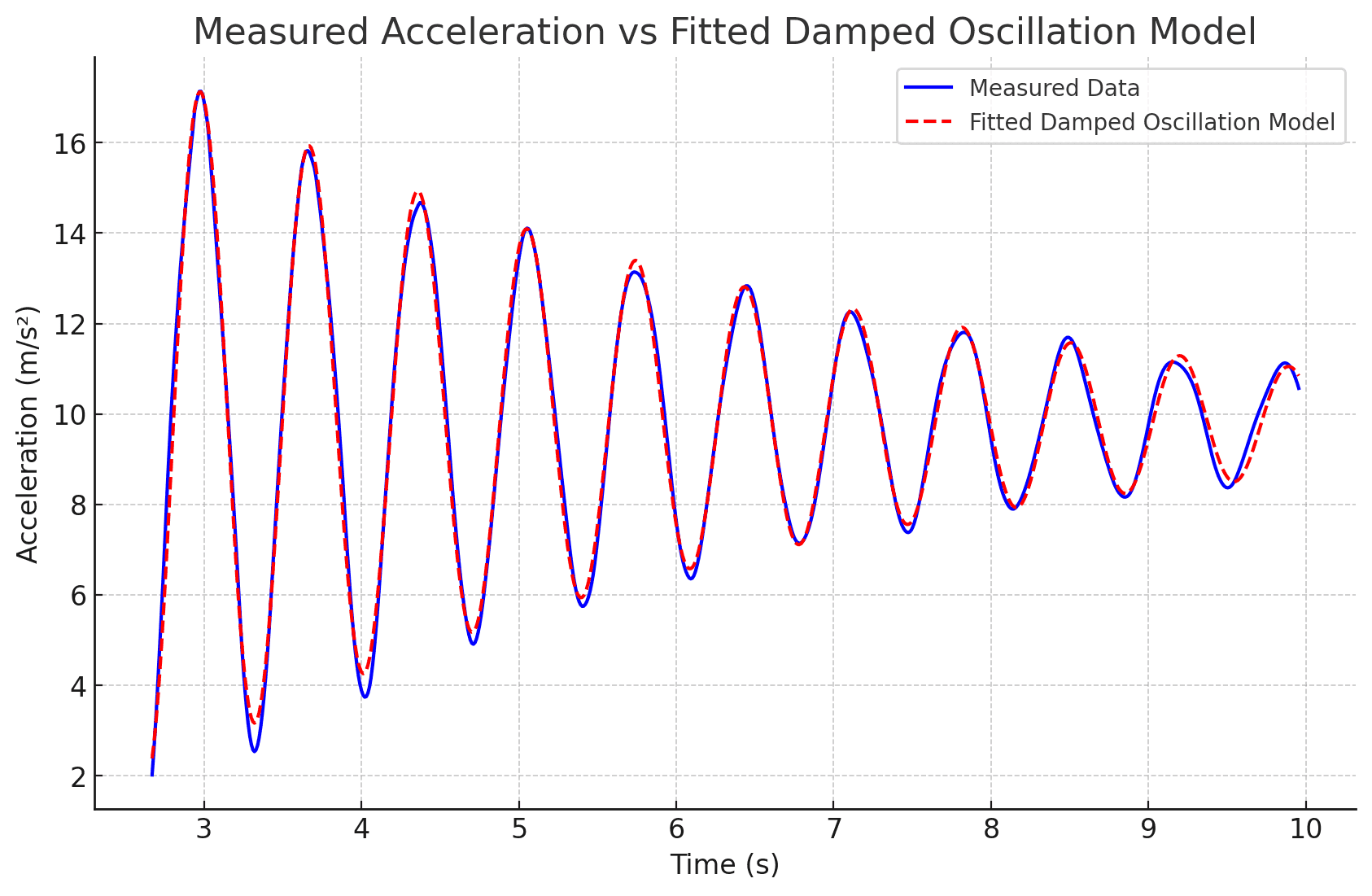
Response: The damped oscillation model fitted to experimental data gives the following parameters:
- Amplitude (A): 15.78
- Damping factor (gamma): 0.26
- Angular frequency (omega): 9.09 rad/s
- Initial phase (phi): -8.23 rad
- Vertical offset: 9.83
The graph shows good correspondence between measured data and the theoretical model, suggesting that the observed movement can be well described by a damped oscillation, typical of an elastic pendulum.
Question: How can I simply explain this acceleration equation?
Response: To explain the elastic pendulum acceleration equation simply:
- Amplitude (A): This is the initial force or extent of movement. The larger the amplitude, the faster the pendulum moves at the beginning.
- Damping factor (γ): This is the gradual decrease in pendulum speed due to friction or resistance. This makes oscillations smaller and smaller over time.
- Angular frequency (ω): This is how fast the pendulum oscillates. It depends on the elastic’s stiffness and pendulum mass.
- Phase (φ): This is the pendulum’s starting position in its movement. It affects where it is when we start observing.
- Offset: This is the base value around which oscillation occurs. Here, it can be a kind of “baseline” acceleration.
In summary, this equation says that pendulum acceleration decreases over time due to damping, while oscillating around a central position, following a gradually slowing movement.
Model Study
The model study aims to analyze the behavior of the determined theoretical model. In our study context, the student seeks to understand how different system parameters – such as damping or elastic extensibility – influence elastic pendulum oscillations. Some of these parameters can only be discovered after several back-and-forth questioning rounds, a process that contributes to student learning.
This study often requires creating a computer program to generate curves and facilitate exploration of parameter variations. AI is an excellent programming assistant and can help the student in this creation process. The tool can also perform these analyses online, using natural language.
Sample Dialogue with ChatGPT
Question: Using the model, draw curves for 10 seconds between an elastic with the same characteristics as ours, an elastic without damping, and an elastic with double damping
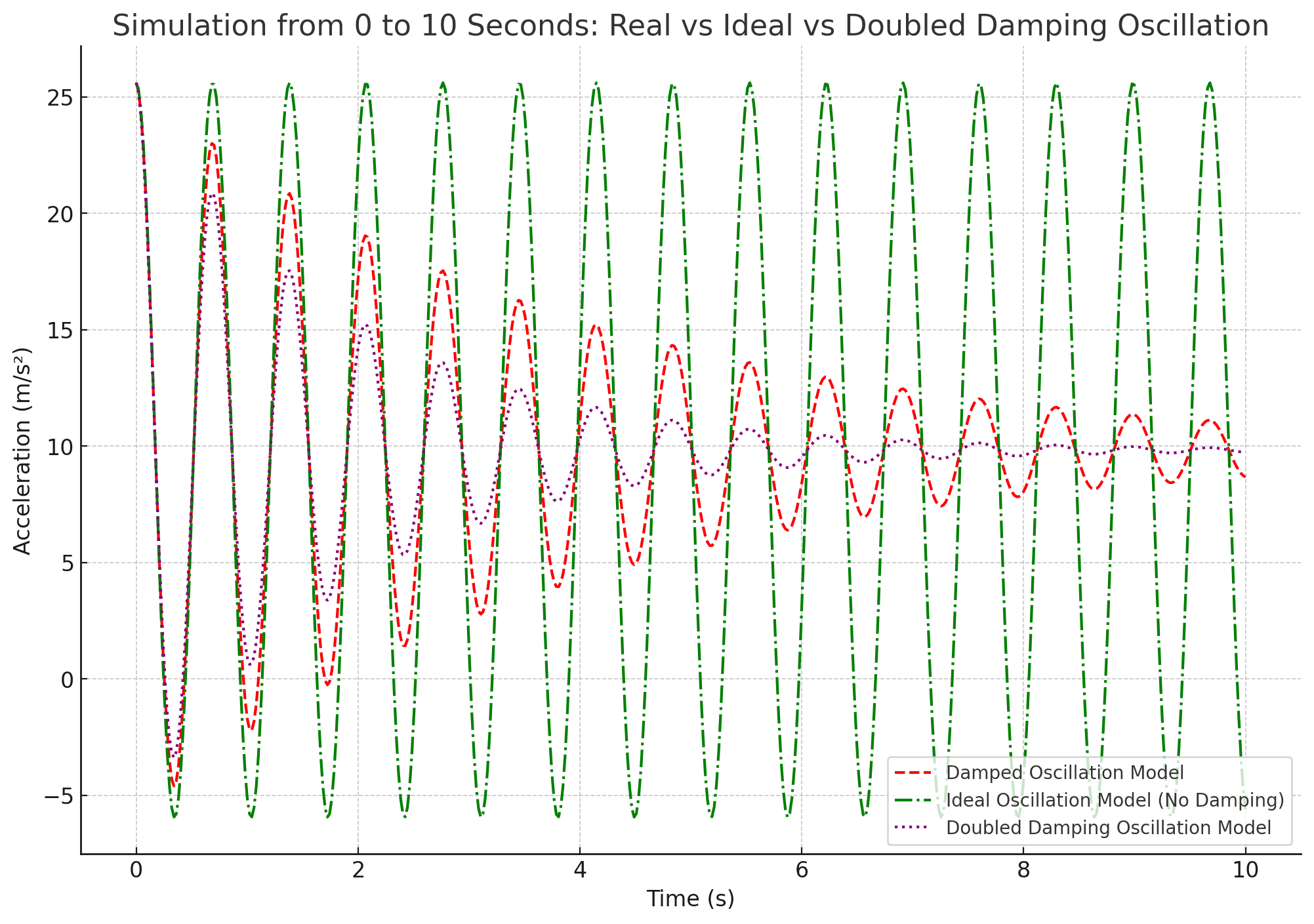
Response: Here is the extended simulation for 20 seconds, showing the behaviors of three types of elastics:
- Red (Extended damped model): Shows continuous decrease in oscillation amplitude due to damping.
- Green (Extended ideal model without damping): Presents constant amplitude oscillations, indicating perpetual motion without energy loss.
- Purple (Model with double damping extended): Oscillation amplitude decreases faster than in the standard damping model, illustrating the effect of stronger damping on how quickly system energy is dissipated.
Question: What is the influence of elastic extensibility on period?
Response: The oscillation period of an elastic pendulum is directly influenced by the elasticity (or stiffness) of the elastic used. This relationship is defined by the elastic’s physical properties, particularly by spring stiffness constant k and suspended mass m.
- Stiffness Constant (k): Spring stiffness constant k measures how difficult the spring is to stretch or compress. The higher k, the stiffer the spring.
- Mass (m): The mass suspended from the spring also affects oscillation period. The heavier the mass, the longer the oscillation period.
- Period Formula: The period T of oscillations for an elastic pendulum (mass-spring system) is given by: T = 2π√(m/k)
This formula shows that period is proportional to the square root of mass and inversely proportional to the square root of stiffness constant.
Communication
Writing a research document is probably the best-known part of generative model applications. AI can help a student write a well-structured, coherent research document adapted to the target audience, offering support throughout the writing process:
- Document structuring
- Clarity and fluidity
- Advice on audience adaptation
- Reminder of elements not to forget
- Coherence in argumentation and scientific reasoning
- Final verification and proofreading
Sample Questions for ChatGPT
- “Can you suggest a complete and logical structure for my scientific research document?”
- “How can I write a clear introduction that presents my research topic and initial hypotheses?”
- “Can you rephrase this passage to make it clearer and easier to understand for a first-year science audience?”
- “What points should I include in the discussion to properly connect my results to the studied theory?”
- “Are my hypotheses, results, and conclusion well connected coherently?”
- “Can you proofread the entire document to correct mistakes and improve style?”
Sharing
Students will probably be interested in another aspect of research: its dissemination. AI can greatly facilitate research document dissemination and optimize its online visibility through SEO (Search Engine Optimization) techniques.
AI can guide the student for these different tasks:
- SEO Optimization: AI suggests relevant keywords, writes optimized title tags and meta-descriptions, and checks keyword density to improve Google ranking.
- Title and Subtitle Creation: It rephrases titles and subtitles to make them catchier and SEO-optimized.
- Summary Writing: AI produces punchy summaries adapted for social networks or newsletters, thus attracting readers.
- Social Media Content: It generates specific posts for each platform (Twitter, LinkedIn, Facebook), ensuring optimal dissemination.
This part of the work also allows students to reflect on how search engines provide their answers.
Conclusion
In this article, we proposed a practical and motivating approach to introduce students to the vast possibilities offered by generative models, by integrating artificial intelligence (AI) into scientific practical experiments.
Although starting from an experiment and data produced by our teams, the dialogue between student and AI is imaginary. We encourage teachers to conduct their own investigation by carrying out this experiment in class.
We are open to your feedback on this experience. AI should not be seen as a solution, neither as a panacea nor as a threat, but rather as a catalyst for reflection and innovation. It helps students not only master sciences but also develop essential digital skills for the 21st century. The challenge now is to find a balance between exploiting this promising technology and maintaining learners’ intellectual autonomy, in order to train critical minds capable of using these tools in an informed and responsible manner.