
Sun height and seasons
Study how the maximum height of the sun in the sky varies throughout seasons using the FizziQ Junior ephemeris and inclinometer.
Activity Summary
Students measure the sun's height in the sky using the tablet's vertical inclination and compare their measurements with FizziQ Junior ephemeris data. By exploring different dates, they discover that the sun's maximum height varies with seasons and is related to Earth's axis tilt.
Introduction
Why is it hotter in summer than in winter? Many people think it's because Earth is closer to the Sun in summer, but that's wrong! In reality, it's the height of the Sun in the sky that changes with seasons and explains temperature variations.
In summer, the Sun rises very high in the sky, its rays arrive almost vertically and efficiently heat the ground. In winter, the Sun stays low on the horizon, its rays arrive at an angle and warm the surface less.
This phenomenon is a direct consequence of Earth's rotation axis tilt. Architects know these variations well: they orient windows and house awnings to take maximum advantage of sun in winter while protecting from it in summer.
In this activity, you will measure the Sun's height in the sky with your tablet, then use the FizziQ Junior ephemeris to explore how this height changes throughout the year. You will discover at what date the Sun is highest and lowest, and you will understand why seasons exist.
Learning Objectives
- Experimentally measure the sun's height in the sky using the FizziQ Junior inclinometer.
- Use the Sun-Moon ephemeris to determine sun elevation at different dates.
- Identify solstice and equinox dates from maximum elevation data.
- Understand the link between sun height, seasons, and Earth's axis tilt.
- Discover the difference between solar time and legal time.
Scientific Concepts
Instruments and sensors
Scientific instruments
- Vertical inclination (inclinometer)
Sensors
- Accelerometer
FizziQ Features
- Sun-Moon ephemeris — Consulted to obtain the sun's calculated elevation for each tested date and to check it against the measured tilt angle, identifying the solstices and equinox.
- Experiment notebook — Used to record each sun height measurement and a photo of the tablet setup for every date explored.
Required Materials
- - Smartphone or tablet with FizziQ Junior - A rigid notebook or flat surface to place the tablet - FizziQ Junior experiment notebook (to record measurements and photos) - Note: the protocol remains adaptable to any comparable inclination/angle measurement tool.
Experimental Protocol
Explain to students that the sun's height varies in the sky during the day due to Earth's rotation. Indicate that maximum height also depends on the observer's position and seasons.
Divide students into groups of 3-4. SAFETY WARNING: students must never look directly at the Sun, this can cause irreparable damage to eyesight.
Open FizziQ Junior and access the Vertical Inclination instrument. Place the tablet flat on the ground then raise the left side: the inclination is shown in degrees.
To measure sun height, place the tablet on a notebook on the ground and orient it toward the sun. By progressively raising the tablet, observe that its shadow shrinks. When the shadow is smallest, the tablet is oriented toward the sun and the displayed angle corresponds to sun height.
Students add this measurement to the experiment notebook and take a photo of the setup.
Ask them to find on FizziQ Junior the Sun-Moon ephemeris which provides the sun's position in the sky for each day of the year. Explore the information provided by this instrument.
Students verify if ephemeris data matches their experimental sun height measurement.
Ask them at what time of day the sun is highest in the sky. By comparing with the time shown on the tablet, they will discover a difference between solar time and legal time.
Ask them if the sun's maximum height is the same for different dates. By changing the date on the tablet and consulting the ephemeris, they explore different dates of the year.
Students determine the dates when the sun is highest (summer solstice) and lowest (winter solstice) in the sky. What time of year do these dates correspond to?
Encourage students to reflect on the importance of understanding these variations for practical applications: energy-efficient house design, solar panels, understanding climate variations.
Printable version: lab handout (PDF) with the protocol, materials and questions, for students without a screen in front of them.
Expected Results
Students will observe that the sun's maximum height varies considerably with seasons. In France (latitude 48°N approximately), the sun reaches a maximum height of about 65 degrees at the summer solstice and only 18 degrees at the winter solstice. At equinoxes, the maximum height is about 42 degrees.
Students will also discover that the sun is at its highest around solar noon, which doesn't correspond exactly to 12:00 legal time due to time zone differences and the equation of time. The experimental measurement with the tablet shadow will be approximate with precision of a few degrees, which is sufficient to observe general trends.
Scientific Questions
- Why is the sun higher in the sky in summer than in winter?
- What would happen if Earth's axis were not tilted relative to its orbit?
- Why doesn't solar noon correspond exactly to 12:00 on our watches?
- Is the sun's maximum height the same in New York and Miami?
- How do architects use knowledge of sun height to design energy-efficient buildings?
Scientific Background
The Sun's height in the sky varies during the day due to Earth's rotation on its axis. Earth completes a full rotation on itself in 24 hours, which makes the Sun appear to move from east to west in the sky.
In the morning, at sunrise, the Sun is near the eastern horizon. It gradually rises until reaching its maximum height at solar noon, then descends toward the western horizon until sunset.
The Sun's maximum height in the sky depends on three factors: Earth's rotation axis tilt (about 23.5 degrees), the observer's latitude, and Earth's position in its orbit around the Sun, i.e., the season.
We can calculate the Sun's maximum height from latitude. At summer solstice, it equals (90 - latitude + 23.5) degrees, or about 65 degrees for Paris (latitude 48°N). At winter solstice, it equals (90 - latitude - 23.5) degrees, or about 18 degrees for Paris. At equinoxes, it equals (90 - latitude) degrees, or about 42 degrees.
Understanding Sun height is essential for many applications. Architects use this data to design energy-efficient homes with awnings that let in low winter sun but block high summer sun. Solar panel installers orient panels to capture maximum light.
Extensions
- Measure sun height at several times of day to trace its trajectory in the sky.
- Compare maximum elevation data between two cities at different latitudes using the ephemeris.
- Build a simple sundial using collected data.
- Theoretically calculate the sun's maximum height and compare with ephemeris data.
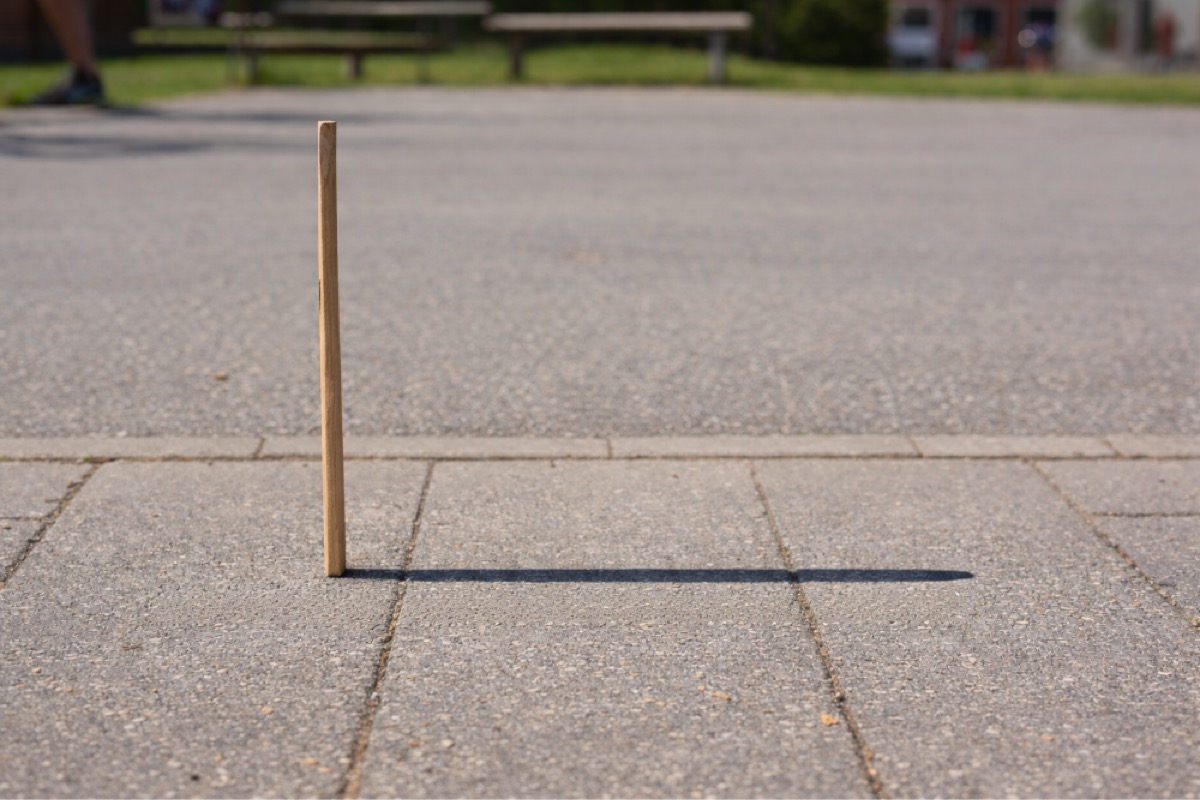
- Study the influence of sun height on shadow length by measuring a vertical stick's shadow.
Frequently Asked Questions
How do I measure sun height without looking directly at the Sun?
Use the shadow method: by tilting the tablet toward the sun while placed on a notebook on the ground, observe that the tablet's shadow shrinks. When the shadow is minimal, the angle displayed on the inclinometer gives sun height.
Why doesn't the experimental measurement exactly match the ephemeris?
Several sources of error exist: difficulty in precisely identifying when the shadow is smallest, tilt sensor imprecision, and the fact that measurement isn't done exactly at solar noon.
Does the ephemeris give the same results everywhere?
No, the ephemeris uses the tablet's GPS position to calculate data. Results will differ depending on the observer's latitude and longitude.
Detailed Description
Students measure the sun's height in the sky using the tablet's vertical inclination and compare their measurements with data from the FizziQ Junior Sun-Moon ephemeris. By exploring different dates of the year, they determine when the sun is highest and lowest in the sky, discover the difference between solar time and legal time, and relate these observations to seasons and Earth's axis tilt. FizziQ Junior's Vertical inclination instrument reads the tilt angle directly in degrees from the tablet's accelerometer, and its experiment notebook lets students log each angle measurement together with a photo of the setup for later comparison with the ephemeris.
Ready to start?
Download FizziQ and try this activity with your students.