
Galileo's inclined plane: d ∝ t²
Verify Galileo's law on the inclined plane: the distance traveled is proportional to the square of time, and the acceleration equals g × sin(α).
Activity Summary
The student uses the FizziQ Web Inclined Plane simulation to record a ball's position versus time for different angles. They verify that distance is proportional to t² (uniformly accelerated motion) and that acceleration equals g × sin(α).
Introduction
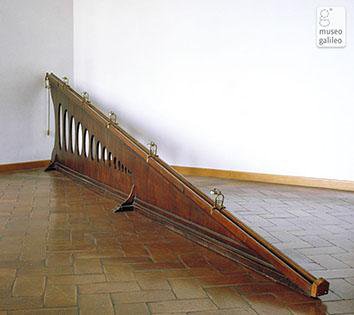
In 1604, Galileo had a brilliant idea: to study falling objects, which were too fast to measure by eye, he 'diluted gravity' by rolling balls down an inclined plane. He discovered that the distance traveled was proportional to the square of the elapsed time. This fundamental relationship, d = ½at², became the foundation of kinematics. The FizziQ Web Inclined Plane simulation lets you reproduce Galileo's experiment and verify his law by measuring position versus time for different inclination angles, then showing that the acceleration is proportional to the sine of the angle.
Learning Objectives
- Measure the acceleration of a ball for different inclination angles
- Verify the relationship a = g × sin(α)
- Plot and interpret d versus t² graphs to extract the acceleration
- Determine the value of g from the slope of the a versus sin(α) graph
Scientific Concepts
Instruments and sensors
Scientific instruments
- FizziQ Web Inclined Plane simulation
FizziQ Features
- Experiment notebook — automatically receives the position-time data from each simulated run and hosts the graphs (d vs t², a vs sin α)
- Calculated column — used to add the t² column needed to linearize the distance-time data
Required Materials
- - Computer, tablet, or smartphone with FizziQ Web - Note: the protocol remains adaptable to any comparable simulation or data-analysis tool.
Experimental Protocol
Open the Inclined Plane simulation in FizziQ Web (Experiment → Simulations → Inclined Plane).
Set the inclination angle to 30° and the travel distance to maximum. Start a recording (REC) and let the ball roll to the bottom.
The position-time data are automatically exported to the experiment notebook. Observe the graph: the curve is not a straight line but a parabola.
Add a calculated column to the table: t² (time squared). Plot the graph of distance versus t². This should be a straight line through the origin.
The slope of this line equals ½ × a. Calculate the acceleration a for the 30° angle. Note the value in a summary table.
Repeat the experiment for angles 10°, 20°, 40°, 50°, and 60°. For each angle, calculate the acceleration from the slope of d(t²).
Create a summary table with three columns: Angle, sin(angle), and Acceleration.
Plot the graph of Acceleration versus sin(angle). The curve should be a straight line through the origin.
The slope of this line gives the value of g. Compare your value with 9.81 m/s².
What happens at an angle of 90°? The acceleration should equal g: that is free fall!
Printable version: lab handout (PDF) with the protocol, materials and questions, for students without a screen in front of them.
Expected Results
The d(t) graph is a parabolic curve, confirming non-uniform motion. The d(t²) graph is a straight line through the origin, confirming d = ½ × a × t². The acceleration increases with angle: approximately 1.7 m/s² at 10°, 4.9 m/s² at 30°, and 8.5 m/s² at 60°. The graph a(sin α) is a straight line through the origin with slope g ≈ 9.81 m/s². The mass of the ball does not affect the results.
Scientific Questions
- What does the slope of the d(t²) graph represent?
- Why does the acceleration not depend on the mass of the ball?
- If you double the angle from 15° to 30°, does the acceleration double?
- What would change if there were friction between the ball and the plane?
- At what angle is the acceleration exactly half of g?
Scientific Background
On an inclined plane, the weight of the ball decomposes into two components: a component **perpendicular** to the plane (balanced by the normal reaction) and a component **parallel** to the plane that drives the ball downward: **F_parallel = m × g × sin(α)**.
By Newton's second law (F = m × a), the ball's acceleration is **a = g × sin(α)**. The mass m cancels out, so the acceleration is independent of mass — just as Galileo discovered.
The larger the angle, the larger sin(α), and the stronger the acceleration. At the limit, for α = 90°, sin(90°) = 1 and a = g: this is free fall.
The motion is **uniformly accelerated** because the acceleration is constant (the simulation does not model friction). The position follows **d = ½ × a × t²** and the velocity follows **v = a × t**.
To verify the proportionality d ∝ t², one plots d versus t²: if it is a straight line through the origin, the relationship is confirmed. The slope gives ½a, from which the acceleration is extracted.
Extensions
- Compare the times to travel the same distance at two different angles
- Predict the acceleration for a new angle before measuring it, then check your prediction
- Add friction in the simulation (if available) and observe how the acceleration changes
- Determine the value of g by using only two different angles
Frequently Asked Questions
The d(t²) graph is not exactly a straight line.
Check that the ball starts from rest (zero initial velocity). If it has an initial velocity, the relationship becomes d = v₀t + ½at² and the graph of d(t²) is no longer a simple straight line.
My calculated value of g is not exactly 9.81 m/s².
Small deviations are normal due to measurement precision in reading the graph. A value between 9.5 and 10.1 m/s² is a good result.
Why did Galileo use an inclined plane instead of free fall?
In Galileo's time, there were no precision clocks. Free fall was too fast to measure (about 0.45 s for 1 m). The inclined plane slowed the motion by a factor of 1/sin(α), making it measurable.
Does the shape or size of the ball matter?
In this idealized simulation without friction, no. In reality, a rolling ball has rotational inertia that reduces the linear acceleration by a factor of 5/7.
Detailed Description
The student uses the FizziQ Web Inclined Plane simulation to record a ball's position versus time for different angles. They verify that distance is proportional to t² (uniformly accelerated motion) and that acceleration equals g × sin(α). FizziQ Web runs the simulated inclined-plane trial and streams the position-time data straight into the experiment notebook, where the t² calculated column and the d(t²) and a(sin α) graphs are built directly on the recorded data.
Ready to start?
Download FizziQ and try this activity with your students.