
Thermal convection in water
Observe convection currents in a heated liquid by measuring temperature at two heights with FizziQ Connect.
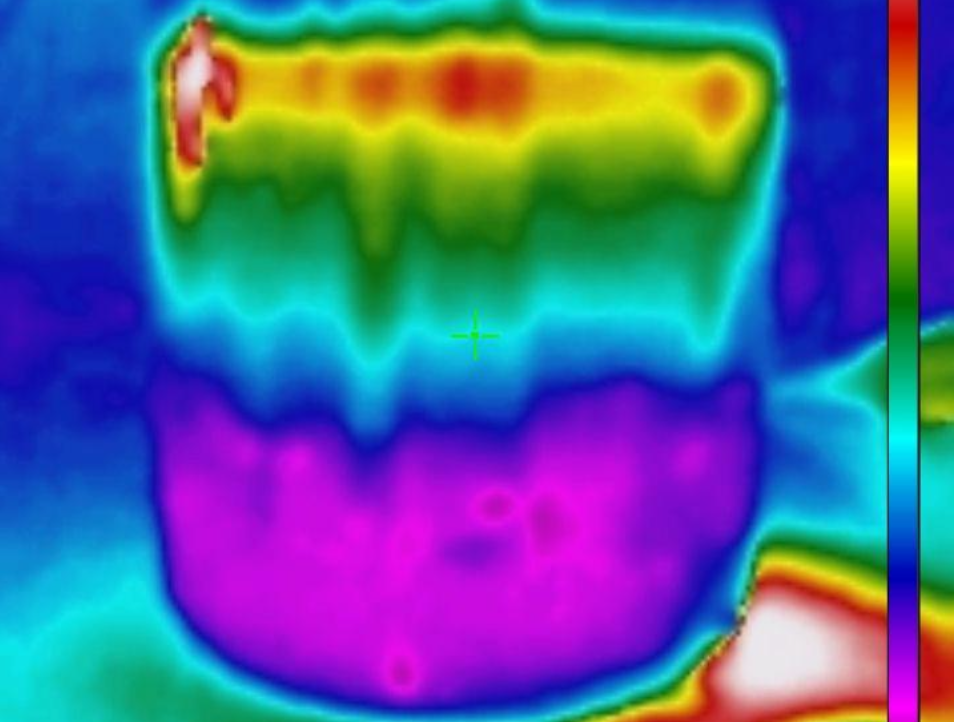
Activity Summary
The student measures temperature at two heights while heating water from below, observing convective heat transport.
Introduction
How does heat propagate through a liquid? Unlike solids where transfer occurs mainly by conduction, liquids heated from below develop convection currents: hot fluid rises because its density decreases, while cooler fluid sinks to replace it. By placing two temperature probes at different heights in a beaker heated from below, you can observe this convective transport in real time.
Learning Objectives
- Measure temperature simultaneously at two positions in a fluid
- Interpret the temperature difference between upper and lower probes
- Identify the three phases: heating with gradient, simmering, and boiling
- Understand the three modes of heat transfer: conduction, convection, radiation
Scientific Concepts
Instruments and sensors
Scientific instruments
- Dual-channel temperature data logger
Sensors
- Temperature probe (x2)
FizziQ Features
- Dual-channel display — Simultaneous real-time display of both probe temperatures during heating
- Data export — Export of the temperature-time data to overlay and compare the two curves
Required Materials
- - Smartphone or tablet with FizziQ Connect - M5 Stack module with two temperature probes - A beaker (200 mL) - An immersion heater - Lab stand and clamp - Optional: aluminum foil insulation - Note: the protocol remains adaptable to any comparable data acquisition tool.
Experimental Protocol
Connect the two temperature probes to the M5 Stack module via the multiport hub. Verify both temperatures display in FizziQ Connect.
Fill the beaker with cold tap water (about 200 mL). Optional: wrap the beaker in aluminum foil to reduce lateral heat loss.
Fix one temperature probe near the bottom of the beaker (close to the heater, without touching it) and the other near the top (just below the surface).
Place the immersion heater in the water, attached to the lab stand with a clamp. The heating element must be fully submerged near the bottom.
Connect FizziQ Connect via Bluetooth and select dual-screen display to visualize both temperatures simultaneously.
Start the recording (REC). Both probes should show similar temperatures (room temperature).
Turn on the immersion heater. Observe the temperature gap between the two probes in real time.
Continue recording throughout the heating phase (about 15 to 20 minutes), noting the moments of simmering and boiling.
Stop the recording when boiling is well established and both temperatures are stable and equal.
Export the data and superimpose the two temperature-time curves to identify the three phases: heating with growing gap, simmering (gap narrows), and boiling (gap disappears).
Expected Results
From the start of heating, the upper probe warms faster than the lower one, demonstrating upward convective transport. The temperature gap grows during early heating, then narrows at simmering as bubble-driven mixing homogenizes the fluid. At full boiling, both probes read 100°C. Total heating time is typically 15-20 minutes for 200 mL with a standard immersion heater.
Scientific Questions
- How can we explain that the temperatures equalize at boiling?
- What happens if you heat the water from above instead of below?
- Why is convection more efficient than conduction for heat transport in fluids?
- What everyday phenomena involve convection currents?
- How do Rayleigh-Bénard cells relate to atmospheric circulation?
Scientific Background
In a liquid heated from below, the fluid in contact with the heat source expands: its **density decreases** and it rises through buoyancy. Cooler, denser fluid sinks to take its place, creating a convective circulation.
This phenomenon is described by **Rayleigh-Bénard cells**: convection structures in the form of rolls or hexagonal cells that organize the flow pattern.
During the heating phase, the temperature gap between top and bottom increases because convection transports heat upward faster than conduction alone.
At **simmering**, the first vapor bubbles form at the bottom and rise, stirring the liquid. This forced mixing narrows the temperature gap between the two probes.
At **boiling**, the stirring is intense and continuous. All the supplied energy goes into the phase change (vaporization), and the temperature stabilizes at 100°C throughout.
The three modes of heat transfer coexist in this experiment: **conduction** in the beaker walls and between adjacent fluid layers, **convection** in the bulk fluid, and **radiation** from the heater and beaker surface.
Extensions
- Add a few drops of food coloring to visualize the convection currents
- Compare heating rates with and without a lid
- Measure the heat transfer coefficient from the temperature curves and heater power
- Use a larger container and more probes to map the temperature field in 2D
Frequently Asked Questions
The two probes show very different values from the start.
The probes may have a slight calibration offset. Note the initial values and subtract the offset from all subsequent readings.
I do not see a clear temperature difference between top and bottom.
The probes may be too close together. Separate them by at least 5 cm vertically.
The water heats unevenly — one side is hotter.
This is natural convection at work. The flow pattern may favor one side of the beaker.
Can I use a microwave instead of an immersion heater?
No. Microwaves heat water volumetrically rather than from below, so convection currents do not develop in the same way.
Detailed Description
The student places two temperature probes connected to FizziQ Connect at two heights in a beaker of water. A immersion heater warms the water from below. Continuous recording shows that the upper probe warms faster, demonstrating convective heat transport. FizziQ Connect, paired with an M5Stack hub, displays both probe channels live on a dual-screen view and lets the class export the temperature-time data to compare the two heights.
Ready to start?
Download FizziQ and try this activity with your students.