
Elastic shock: Newton's cradle
This activity allows students to verify the conservation of mechanical energy during collisions between the balls of a Newton's pendulum. It develops the ability to analyze energy transfers and understand conservation concepts.
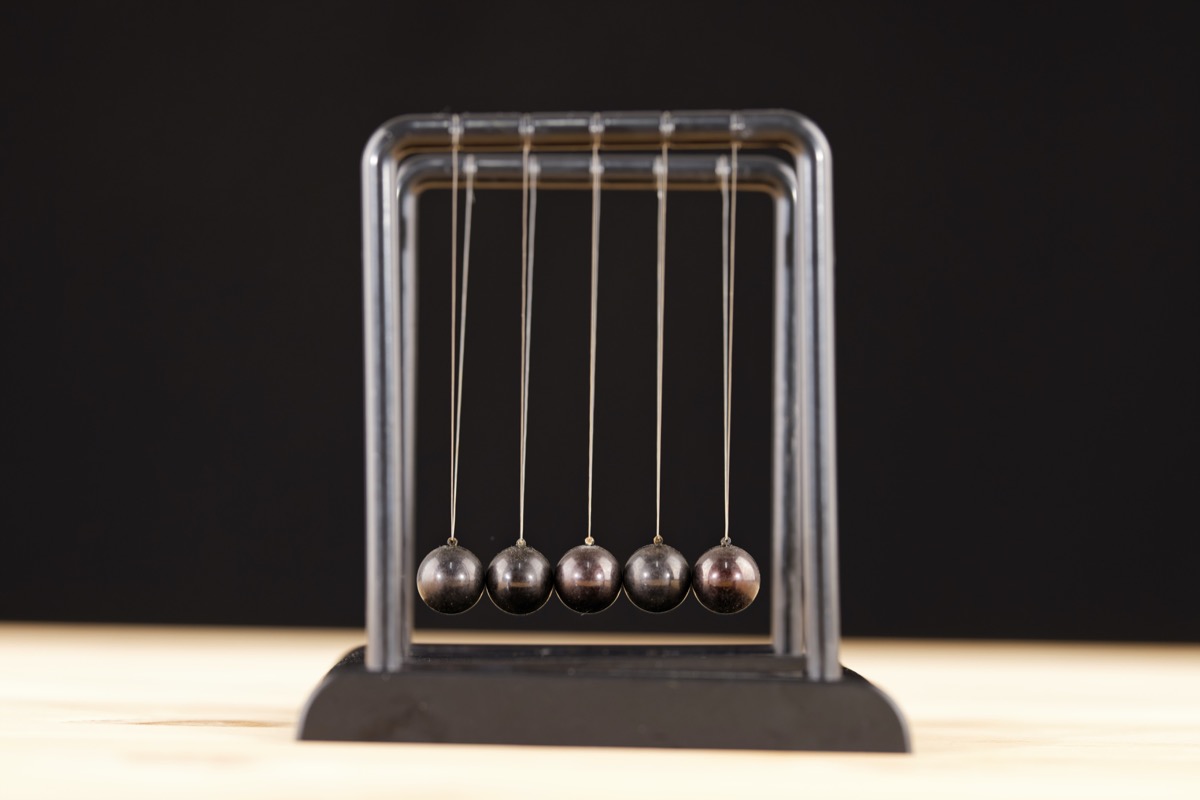
Activity Summary
The student uses the FizziQ kinematic analysis module to study the movement of the balls of a Newton's pendulum before and after impact. By measuring the position and speed of the balls at different times, the student calculates the kinetic and potential energy of the system then compares the values before and after collision to check if the total mechanical energy is conserved.
Introduction
Newton's cradle, the iconic desk toy with five suspended steel balls, has fascinated physicists and office workers alike for decades. When you pull back one ball and release it, something remarkable happens: only the ball at the opposite end swings out, rising to nearly the same height as the first. Two balls in, two balls out. Three in, three out. This elegant demonstration simultaneously illustrates two of the most fundamental conservation laws in physics: conservation of momentum and conservation of kinetic energy. The behavior is only possible because both quantities are conserved in nearly elastic collisions between steel balls. If only momentum were conserved, many different outcomes would be possible. It is the additional constraint of energy conservation that uniquely determines the observed result. This experiment uses FizziQ's kinematic analysis to track the motion of Newton's cradle balls before and after collision, measure their velocities, and verify that both momentum and kinetic energy are indeed conserved.
Learning Objectives
- Measure the velocities of balls before and after impact to calculate momentum and kinetic energy
- Verify that both momentum and kinetic energy are approximately conserved
- Determine the coefficient of restitution for the steel ball collision
- Understand why both conservation laws together determine the unique observed outcome
Scientific Concepts
Instruments and sensors
Scientific instruments
- Video (kinematics) analysis module
FizziQ Features
- Video library — Supplies the pre-recorded 'Newton's Pendulum' video used for the frame-by-frame tracking, so no filming equipment is needed.
Required Materials
- - Smartphone or tablet with the FizziQ app for video kinematic analysis - Video 'Newton's Pendulum' (available from the FizziQ resource library) - Note: the protocol remains adaptable to any comparable video analysis tool.
Experimental Protocol
Open FizziQ and navigate to the **Kinematics** module. Load the **'Newton's Pendulum'** video from the FizziQ resource library.
Set the **scale** using a known dimension in the video (e.g., the diameter of one ball, typically 2-3 cm for a desk toy).
Set the **coordinate origin** at the equilibrium position of the first ball.
Track the **incoming ball** (Ball 1) frame by frame for at least **5 frames before** impact. Record its position at each frame.
Track the **outgoing ball** (the ball at the opposite end) for at least **5 frames after** impact.
Determine the **velocity of Ball 1 before impact** (v₁) from the slope of its position-time graph.
Determine the **velocity of the outgoing ball after impact** (v₂') from the slope of its position-time graph.
Check whether Ball 1 is **stationary after impact** (v₁' ≈ 0), as expected for an elastic collision between identical masses.
Calculate the **momentum before**: p_before = m × v₁ (mass cancels since balls are identical).
Calculate the **momentum after**: p_after = m × v₂'. Compare with p_before.
Calculate the **kinetic energy before**: Ec_before = ½mv₁². Calculate **Ec_after = ½mv₂'²**. Compare.
Calculate the **coefficient of restitution**: e = v₂' / v₁. For a perfectly elastic collision, e = 1.
If possible, repeat the analysis for the case of **two balls** released simultaneously, tracking both incoming and outgoing balls.
Expected Results
For a well-made Newton's cradle with steel balls, the incoming ball should nearly stop after impact (v₁' ≈ 0) and the outgoing ball should leave at approximately the same speed (v₂' ≈ v₁). The coefficient of restitution should be between 0.90 and 0.98. Momentum conservation should hold within 5-10% (p_before ≈ p_after). Energy conservation should also hold within 5-15%, with small losses due to sound production, slight deformation, and energy transfer to the intermediate balls. For the two-ball case, both outgoing balls should have approximately the same speed as the incoming pair. Tracking precision is limited by the video frame rate and the fast motion of the balls near impact.
Scientific Questions
- What would happen if the balls had different masses?
- Why is both momentum AND energy conservation necessary to predict the outcome?
- What fraction of energy is lost in each collision? Where does this energy go?
- Why do the oscillations eventually stop in a real Newton's cradle?
- How would the behavior change if the balls were made of clay instead of steel?
Scientific Background
Newton's pendulum, named after Isaac Newton although he was not its inventor, is a device that perfectly illustrates the principles of conservation of momentum and mechanical energy. It usually consists of five identical metal balls suspended side by side.
When you move a ball aside and release it, it hits the others and, surprisingly, only the ball at the opposite end rises, and to the same height as the first. Physically, two principles are at work: 1) The conservation of momentum: mv₁ = mv₂ (where m is the mass of the balls and v₁, v₂ the velocities before and after collision); 2) Conservation of mechanical energy: ½mv₁² = ½mv₂² (neglecting losses).
For a perfectly elastic shock, these two laws impose that in a system of two identical masses, all of the kinetic energy is transferred from the first mass to the second. In a real pendulum, shocks are never perfectly elastic: part of the energy is converted into heat, vibrations or sound waves.
The restitution coefficient e characterizes this loss of energy: e = √(E₂/E₁), where E₁ and E₂ are the mechanical energies before and after collision. For a perfectly elastic shock, e = 1; for a totally inelastic shock, e = 0.
The kinematic analysis of FizziQ makes it possible to precisely measure the energies at different times and to calculate this coefficient. Commercial Newton pendulums typically have a coefficient e between 0.9 and 0.95.
This experiment provides a visual understanding of abstract concepts such as conservation of energy and momentum, and illustrates the difference between theoretical models (perfect conservation) and physical reality (inevitable losses).
Extensions
- Analyze the gradual decrease in amplitude over many cycles and quantify energy dissipation
- Replace one ball with a different material or mass and observe how the behavior changes
- Use the height of the outgoing ball to verify energy conservation independently of velocity measurements
- Compare a Newton's cradle with a simple two-ball collision on a flat surface
Frequently Asked Questions
The balls move too fast to track accurately in the video. What can I do?
Focus on tracking the balls in the slow-moving portions of their swing (near the turning points where they momentarily stop). Use the height at the turning point to calculate velocity via energy conservation: v = √(2gh).
The outgoing ball does not reach the same height as the incoming ball. Is energy not conserved?
Small energy losses (2-10%) are normal due to sound, heat, and slight inelastic deformation. A height difference of 5-10% is typical for a good Newton's cradle.
Why do the middle balls appear not to move during the collision?
The collision propagates through the middle balls as a compression wave at the speed of sound in steel (~5000 m/s). This transit takes less than 0.1 milliseconds, far too fast to see or to resolve in a normal video.
Can I use my own Newton's cradle instead of the library video?
Yes, record a slow-motion video with a fixed camera positioned at the level of the balls. Include a ruler or known reference in the frame for scale calibration.
Detailed Description
The student uses the FizziQ kinematic analysis module to study the movement of the balls of a Newton's pendulum before and after impact. By measuring the position and speed of the balls at different times, the student calculates the kinetic and potential energy of the system then compares the values before and after collision to check if the total mechanical energy is conserved. FizziQ provides this measurement through its Kinematics module, which performs frame-by-frame position tracking directly on the pre-recorded 'Newton's Pendulum' video supplied in its resource library.
Ready to start?
Download FizziQ and try this activity with your students.